You noticed he was slower. Then you noticed he had stopped coming into the kitchen. Nobody tells you those are the same thing.
Here is the order it usually happens in. Not every dog does every step, and the timing is different for each one, but the sequence is consistent enough that you can find yourself on it.
1. The nails get long
It stops being a grooming detail. Once they are long enough, they touch down before the pads do. How to get back to trimming if you stopped.
2. He loses grip
Pads have texture and they flatten a little under weight, and that is what makes friction. Nails are hard points. Hard points on a smooth floor slide. The full list of what changes it.
3. He slips, and he remembers
One slip is an accident. The third one is a decision. He starts going around the room where it happened. Why he avoids the room now.
4. He moves less
Not because he cannot. Because he chose not to. This is the step that costs the most and looks like the least, and it is the one nobody notices while it is happening.
5. He loses muscle
Muscle goes when it is not used. The less he walks, the less he is able to walk. This is where the loop closes on itself.
6. The jump stops being possible
Usually the car first, because it is the highest thing he does in a normal week. He stopped jumping into the car.
7. You start lifting him
And that is usually where people find us. How to carry him up and down stairs.
Why the order matters
Because each step makes the next one more likely. It is not a slope, it is a loop that tightens. The nails cause the slipping, the slipping causes the avoiding, the avoiding causes the muscle loss, and the muscle loss makes every earlier problem worse.
Which also means the opposite is true. You can act one step before where you are standing.
Trimming his nails does not sound like it has anything to do with carrying him up a staircase. It is the first link in the same chain.
Where is he now
You do not need all of it. You need the one where he is right now.
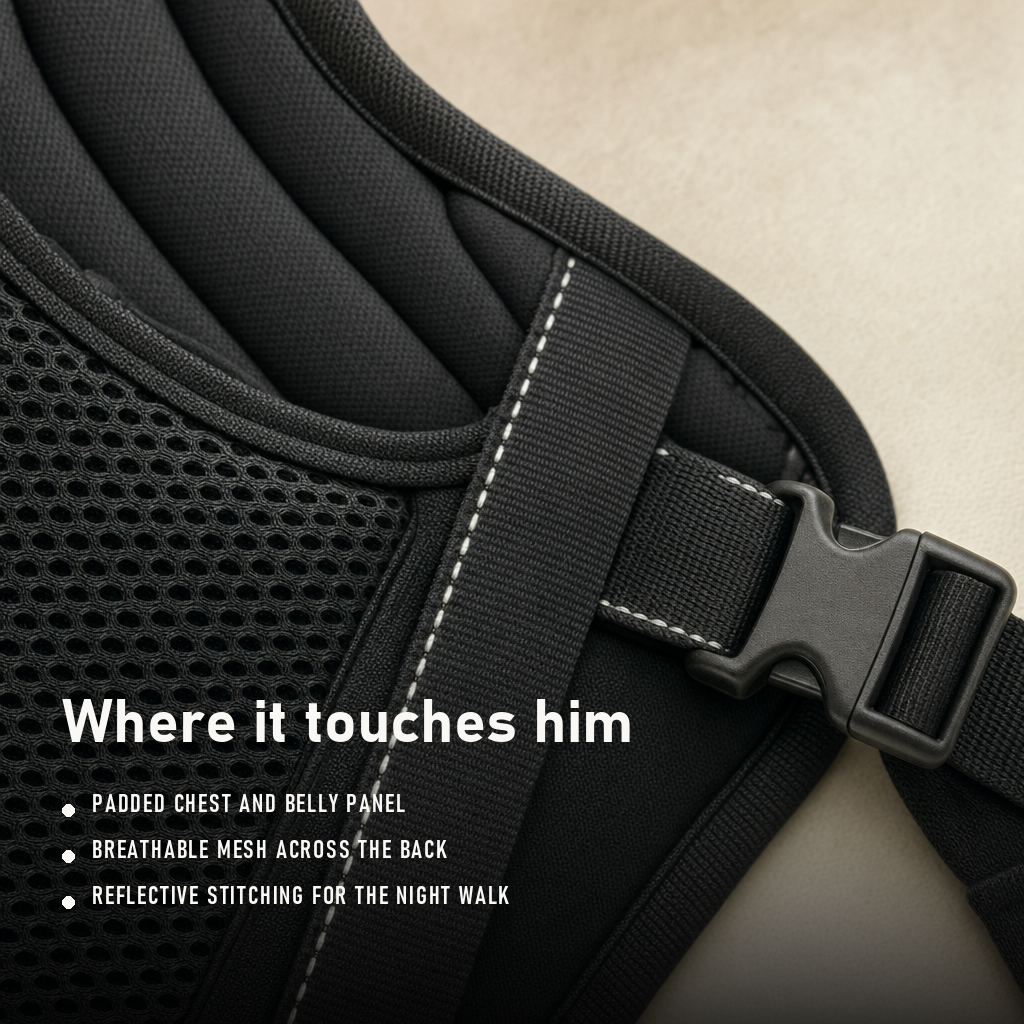
If you can hear his nails on the floor, start there. If he already hesitates before the tile, you are at step three. If you are lifting him into the car, a ramp gives him back a step he can still do himself. And if you are already carrying him, a full-body carrier moves that weight off your arms and onto your shoulders.
Measure him before you buy anything.
If any of this came on suddenly, or on one side only, that is a question for your vet first and a question about your floors second.