He is not limping. He gets up when you come home. Nothing looks wrong.
But he used to follow you into the kitchen and now he waits in the hallway. He used to come upstairs at night and now he sleeps by the door. You did not decide any of that. Neither did he, exactly.
The step that has no symptom
Every other change gives you something to look at. Long nails you can see. A slip you can hear. A leg he will not put down you notice in an afternoon.
This one gives you nothing. A dog that moves less looks exactly like a dog that is resting. That is why it runs for months before anyone calls it anything.
Why he chose it
He is not in pain when he lies down. He is avoiding the part that comes before.
If getting up on a smooth floor has gone badly a few times, standing up is no longer neutral. It is a small gamble he now takes on purpose. So he takes it less often. He waits until the reason is good enough.
That is not weakness. It is a reasonable decision made by an animal who remembers.
What it costs
Muscle is maintained by use and nothing else. A dog who walks half as much keeps less of it, and the less he keeps, the harder every stand becomes. Then the gamble gets worse, so he takes it even less.
This is the part of the sequence that closes on itself. The order it happens in explains the whole chain, but this is the link where it stops being a line and becomes a loop.
How to see it, since you cannot see it
You will not catch this by watching him walk. You catch it by noticing where he is not.
- Count the rooms. How many does he go into now, compared to a year ago. Not can, does.
- Watch the invitation. When you get up, does he get up too, or does he look at you and stay.
- Time the stand. Not whether he can, but how many seconds pass between deciding and standing.
- Notice the surface. If he is choosing rugs and carpet over hard floors, that is the reason, not the preference.
What actually reverses it
Two things, and neither is a product.
Make the floor safe again. He stopped moving because moving stopped being safe. Traction is what changes the arithmetic. The full list of what changes it is short and starts with something free.
Keep the distance the same. The walks matter less than the number of times he stands up in a day. Feeding him in a different room than he sleeps in does more for this than an extra block does.
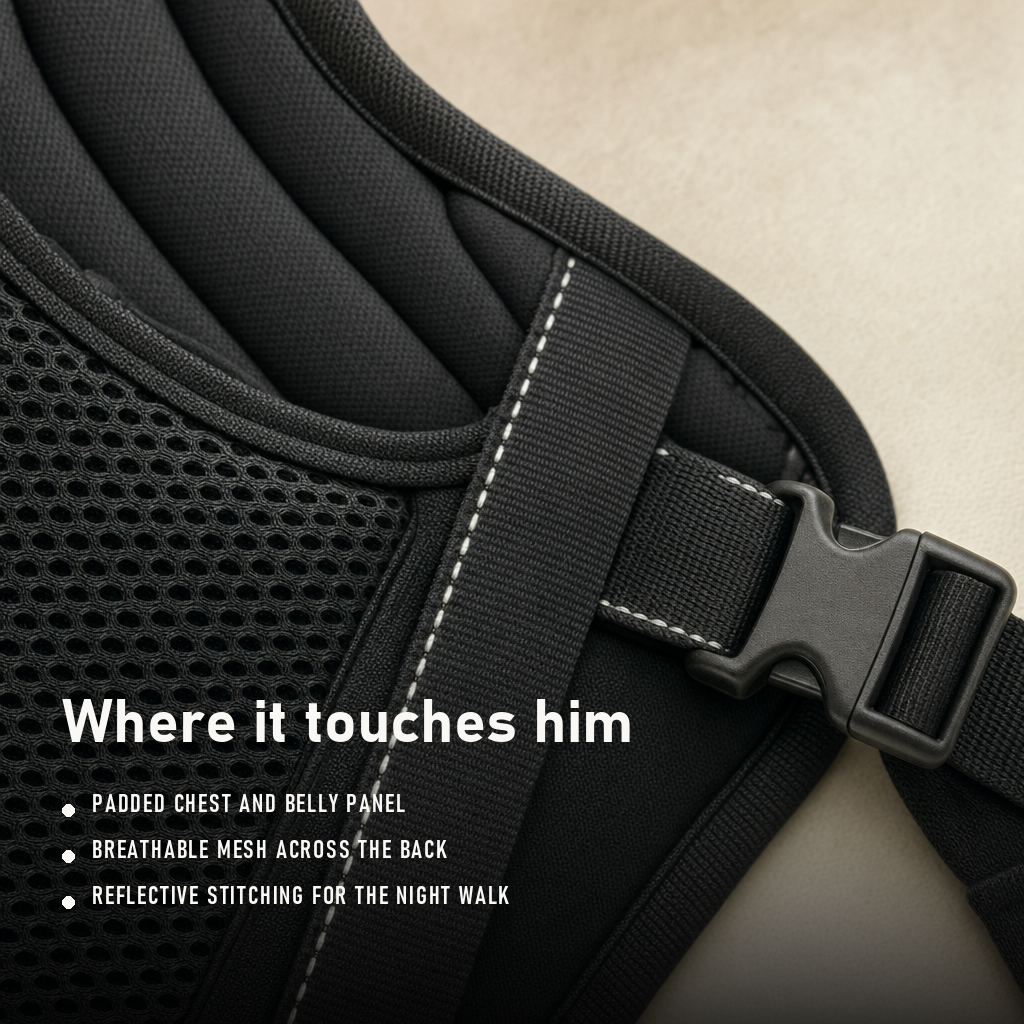
And where he genuinely cannot make a trip, making the trip for him is not giving up. Being carried down the stairs at night and walking on his own in the morning is a better week than skipping both. A full-body carrier exists for that gap, not to replace the walking he can still do.
If he stopped moving suddenly, or seems sore rather than hesitant, that is a vet visit and not a floor problem.